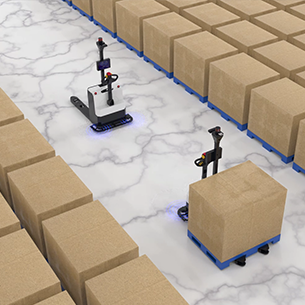

In the highly competitive world of modern manufacturing, Industrial AMR Forklift Efficiency has become the gold standard for production success. As labor shortages continue to impact global supply chains, factories must find smarter ways to move materials without relying solely on human physical strength. Consequently, the introduction of the Reeman autonomous forklift series—such as the Ironhide and Rhinoceros models—is redefining what it means to operate a high-output facility.
The Triple-Shift Advantage of Industrial AMR Forklift Efficiency
The most significant impact of Industrial AMR Forklift Efficiency is its ability to maintain peak performance across multiple work cycles. For example, a single manual forklift requires three different operators to cover a 24-hour period, which involves complex scheduling and frequent downtime. However, an Industrial AMR Forklift Efficiency solution allows one robot to work through all three shifts without breaks or fatigue. Therefore, a single automated unit can effectively match the total daily output of three human employees.
Furthermore, this technology eliminates the performance dips that typically occur during shift handovers. While human workers may experience exhaustion or distractions, the Reeman AMR maintains a consistent speed and precision. Instead of dealing with personnel management issues, factory managers can focus on scaling their operations, knowing that their internal logistics are running at maximum velocity.
Activating New Production Energy with Industrial AMR Forklift Efficiency
To achieve true Industrial AMR Forklift Efficiency, the robot must do more than just move pallets; it must integrate with the factory’s digital heartbeat. Reeman’s robots utilize advanced 3D SLAM navigation to adapt to changing environments in real-time. This flexibility ensures that the production line never stops, even when the floor layout is adjusted. This level of Industrial AMR Forklift Efficiency provides several key advantages:
-
Zero-Wait Logistics: Materials are delivered “Just-in-Time” (JIT) to prevent machine idling.
-
Enhanced Safety Protocols: 360-degree obstacle avoidance reduces the risk of costly workshop accidents.
-
Data-Driven Optimization: Real-time tracking allows managers to identify and eliminate bottlenecks instantly.
In addition to these operational gains, the transition to autonomous handling significantly improves the workplace environment. By delegating repetitive and heavy lifting to robots, human workers can be reassigned to high-value technical roles. In conclusion, if your goal is to maximize throughput while minimizing human dependency, prioritizing Industrial AMR Forklift Efficiency is the most logical step for your business growth.