

Amid the Industry 4.0 wave, smart logistics has become an effective pathway for manufacturing enterprises transitioning toward unmanned and intelligent operations. As a primary implementation of industrial automation logistics, unmanned forklifts are widely used in repetitive handling tasks, high-intensity handling, challenging environments, and settings with strict requirements. 2.5-meter lifting height.
Powerful Performance & Precision Handling
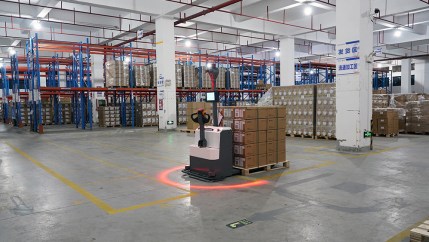
The core advantage of Reeman unmanned forklifts lies in their robust loading and precise operation capabilities. With a maximum 1.5-ton load capacity and 2.5-meter lifting height, they easily handle heavy goods transportation, suitable for automotive manufacturing and large-scale warehousing scenarios. LiDAR + 3D vision recognition technology automatically identifies surrounding environments, while autonomous obstacle avoidance ensures safe operation in complex settings, preventing accident risks.
Continuous Operation & Cross-floor Capability
Reeman AMR unmanned forklifts support battery swapping and automatic charging functions, enabling 24/7 uninterrupted operation and significantly improving equipment utilization. Particularly noteworthy is their ability to automatically use elevators for cross-floor delivery, combined with point-to-point precision transport that maintains centimeter-level accuracy from location A to B. For instance, in logistics centers, these forklifts can autonomously transport pallets from ground level to elevated racks without human intervention, boosting efficiency over 40% compared to traditional forklifts.
Simplified Operation & Significant ROI
The remote one-touch call function further streamlines operational processes, allowing employees to dispatch forklifts for tasks anytime with rapid response that reduces waiting periods. Economically, unmanned forklifts deliver remarkable returns – one unit replaces three skilled workers, saving approximately ¥300,000 annually based on average annual salaries of ¥100,000 per person. Combined with reduced error rates and equipment maintenance costs, the payback period becomes exceptionally short.
Strategic Transformation Tool
Currently, AMR unmanned forklifts represent not just technological products but crucial elements in corporate strategic transformation. They address safety concerns and cost pressures associated with high-intensity labor, especially valuable in post-pandemic environments where contactless operation has become standard. As artificial intelligence and IoT technologies converge, unmanned forklifts will evolve toward greater intelligence and integration. Choosing them means embracing an efficient, secure future – where smart equipment handles heavy loads, freeing human resources for higher-value work and collectively advancing the industry into a new era.
더 보기: 자율 지게차

자율주행 지게차는 자동문 및 스트레치 래퍼와 어떻게 연동될 수 있을까? REEMAN 공장 사례 연구

Built for Rain: REEMAN Waterproof Ant All-Weather Outdoor Autonomous Forklift

REEMAN Ironhide가 원터치 호출로 하루 160–200회의 팔레트 운반을 자동화하는 방법

2T 자율주행 지게차 렌탈 vs. 구매: 중공업 제조에서 월간 운영 비용 계산하기

자율 지게차 리스 대 구매: 1.2T 카운터밸런스형 모델의 TCO 분석

Titan Mini 자율 지게차 vs 수동 팔레트 잭: 1.8미터 통로에 어떤 것이 더 적합할까?