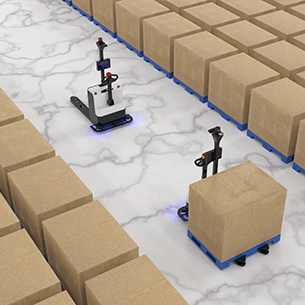

Walk through a modern furniture factory and you will likely see impressive machinery at every workstation — robotic panel saws delivering precise cuts, CNC machining centers routing complex profiles, edge banders producing seamless finishes at high speed. Yet between those automated islands, you will often still find a forklift driver manually shuttling panels from the saw to the edge bander, a worker hand-stacking finished carcasses before a supervisor figures out where to store them, and a loading dock crew spending hours building outbound pallets by hand. The production machines are automated, but the material flow connecting them is not.
This disconnect is the central challenge of furniture manufacturing automation today. Cutting and processing equipment has advanced enormously over the past decade, but the logistics layer — how raw panels arrive at the first machine, how work-in-progress moves between stations, and how finished goods travel to the outbound dock — often remains a fragmented patchwork of manual labor, forklift traffic, and inefficient staging. The result is that expensive CNC machines sit idle waiting for material, throughput is capped by human movement speeds, and labor costs remain stubbornly high even after significant machinery investment.
This guide maps the complete automation journey in furniture manufacturing, stage by stage from raw panel intake through to the outbound dock. At each step, we examine where autonomous mobile robots (AMRs) and autonomous forklifts transform disconnected production islands into a single, continuously flowing smart factory — and how Reeman’s AI-powered robotics platform makes that transformation achievable for manufacturers of all sizes.
The Automation Gap Most Furniture Factories Still Have
The furniture industry has invested heavily in processing automation over the past decade. Panel saws, CNC nesting centers, edge banders, and drilling lines have all become faster, more precise, and more software-driven. Yet despite these gains, material handling remains one of the largest remaining sources of waste and cost in most furniture plants. Research has found that material handling can account for up to 25% of manufacturing labor costs and as much as 15% of total production costs — a figure that compounds across every shift and every production run.
The core problem is that furniture factories have historically automated their processing steps as isolated cells rather than as an integrated flow. The panel saw is automated. The edge bander is automated. The drilling center is automated. But the connections between them — the transport of panels, offcuts, WIP carcasses, and finished goods — are often handled manually, with traditional forklifts, hand trucks, or simple conveyors that can’t adapt to varying batch sizes or the demands of mixed-SKU, batch-size-one production environments.
This gap becomes especially costly as the industry shifts toward greater personalization and shorter order cycles. Manufacturers producing hundreds of unique SKUs per day cannot afford the delays and errors that come from coordinating manual logistics across a complex production floor. The solution is not simply to add more workers — labor shortages and rising wage costs make that model increasingly unviable. The answer is to automate the material flow itself, creating a continuous, intelligent transport layer that connects every production island from the first panel cut to the final truck load.
Stage 1: Raw Material Intake and Panel Storage
Automation in a furniture factory begins before a single panel enters the saw. Large board panels — MDF, particle board, plywood, and solid timber sheets — arrive at the inbound dock on pallets and must be transported to storage racks or directly to production lines. This task is physically demanding, time-consuming, and prone to damage if panels are mishandled. Traditionally, a forklift operator manages this process, but manual inbound logistics creates variable throughput and makes it difficult to maintain a consistent, orderly storage layout.
Autonomous forklifts can take over this entire inbound flow. Once pallets are offloaded from trucks and scanned at the receiving dock, an autonomous forklift receives a task assignment from the warehouse management system (WMS) and navigates independently to pick up the load, transport it to the designated storage lane, and position it with millimeter-level accuracy. This happens continuously, without operator involvement, and without the variability that comes from shift changes or operator fatigue.
The benefits at this stage extend beyond speed. Accurate, automated putaway means that every panel pallet is precisely located in the system, eliminating the time-consuming search processes that slow down panel retrieval later in production. Automated inbound handling also reduces the risk of panel surface damage — a significant quality concern for furniture manufacturers working with high-gloss or pre-finished boards. Reeman’s Rhinoceros Autonomous Forklift is purpose-built for exactly this kind of high-payload, high-precision inbound handling, combining laser-guided navigation with SLAM mapping to operate reliably in the dynamic, variable conditions of an active receiving area.
Stage 2: Panel Saw and Cutting Cell — Where Automation Begins
The panel saw or nesting CNC is typically the first major processing station in a furniture production line, and it is where most manufacturers have already invested significantly in automation. Modern robotic panel saws can process up to 3,000 parts per shift with high dimensional accuracy, supporting everything from large-run series production to batch-size-one custom orders. Software-driven cutting optimization reduces offcut waste and ensures that each panel is utilized to its maximum potential.
However, the cutting cell’s efficiency is only as good as the material supply feeding it. If an operator must manually retrieve board panels from the storage rack, load them onto the saw infeed, and then physically stack and transport cut parts to the next station, the automated saw spends significant time waiting. The loading and unloading of the cutting cell is where intelligent mobile robotics has its first major impact in the furniture production workflow.
An autonomous delivery robot or a compact AMR chassis can be deployed to continuously supply full panel boards to the saw infeed from the storage area, running on a programmed route that is dynamically updated based on production scheduling data. After cutting, stacked part packets are picked up by an autonomous forklift and transported directly to the next processing station — whether that is an edge bander, a buffer sorter, or a labeling station — without any manual intervention. This creates a truly automated cutting cell where the saw runs at its rated capacity throughout the shift, not just when a forklift operator happens to be available.
Stage 3: WIP Transport — The Hidden Bottleneck Between Machines
If there is a single point in a furniture factory where automation investment delivers the most immediate and visible payback, it is work-in-progress (WIP) transport between processing stations. This is the movement of cut panels from the saw to the edge bander, from the edge bander to the CNC drilling line, from drilling to assembly, and from assembly to the finishing or packaging area. In most factories, this movement is entirely manual — performed by operators pushing carts, driving manual forklifts, or carrying parts on shoulder. It is also where material queues build up, where sequencing errors occur, and where the floor becomes cluttered with staging stacks that obscure visibility and create safety hazards.
Autonomous mobile robots transform WIP transport from a reactive, labor-driven process into a predictable, data-driven flow. AMRs can be programmed to run continuous “milk run” circuits between stations, picking up completed batches from the outfeed of one machine and delivering them to the infeed of the next — all without fixed conveyor infrastructure and without any manual driving. Because modern AMRs use SLAM-based navigation and real-time obstacle avoidance, they operate safely alongside human workers on a shared floor, automatically rerouting around obstacles and people without stopping production.
The flexibility of AMR-based WIP transport is a critical advantage in furniture manufacturing, where production layouts frequently change, batch sizes vary dramatically, and the same floor area may need to support multiple product families simultaneously. Unlike rigid conveyor systems that lock a factory into a fixed layout, AMRs can be redeployed to new routes in hours, supporting production line reconfigurations without major capital investment. Reeman’s IronBov Latent Transport Robot and the versatile Fly Boat Delivery Robot are ideal for these inter-station WIP missions, offering robust payloads and reliable navigation in the dusty, dynamic environment of an active woodworking facility.
Stage 4: Edge Banding, Drilling, and Assembly — Keeping the Line Fed
Edge banding machines, CNC drilling centers, and assembly stations all share the same vulnerability: they are highly productive when continuously fed with correctly sequenced parts, and they are expensive to leave idle. In a manual material flow environment, the operators at these machines frequently become their own material handlers — pausing production to retrieve the next batch, sort incoming parts, or clear finished stacks from the outfeed area. This multitasking reduces effective machine utilization and introduces sequencing errors that can compromise batch-size-one production requirements.
Automated material flow at this stage means dedicated AMRs are assigned to each processing cell, responsible for presenting parts in the correct sequence on the infeed side and removing completed parts from the outfeed side as soon as they are ready. With real-time coordination from a fleet management system, the robots maintain a buffer of the right parts at each station, ensuring that machine operators can focus entirely on quality control and machine oversight rather than logistics.
For assembly stations handling larger sub-assemblies — cabinet carcasses, drawer boxes, or panel packs — autonomous forklifts with appropriate payload capacity take over from AMRs. The transition between AMR and forklift transport is managed by the central fleet management software, which assigns the right vehicle to the right task based on load weight, destination, and current traffic on the floor. This coordinated multi-robot approach eliminates the bottlenecks that normally accumulate between drilling and assembly in high-volume furniture operations. Reeman’s Ironhide Autonomous Forklift is well-suited for these medium-payload inter-station missions, offering precise navigation and safe co-existence with human workers in confined production environments.
Stage 5: Finished Goods Handling and Warehouse Storage
Once furniture components or assembled units have completed the production process, they move into finished goods handling — one of the most labor-intensive phases in the traditional furniture factory. Completed units must be inspected, labeled, wrapped or packaged, stacked onto pallets, transported to the finished goods warehouse, and stored in an organized fashion that supports accurate inventory management and efficient order picking. In many facilities, this entire process relies on manual forklift operators working from paper or handheld scanner instructions, with accuracy and throughput varying significantly between shifts.
Autonomous forklifts excel in finished goods handling precisely because this phase involves highly repetitive, predictable movements — picking pallets from a wrapping station, transporting them to designated storage lanes, and positioning them with consistent accuracy. Unlike manual operators whose speed and precision fluctuate with fatigue levels and shift timing, autonomous forklifts deliver the same performance on the 100th pallet of a shift as on the first. This consistency is critically important for furniture manufacturers whose finished goods are high-value and can be damaged by rough or inaccurate stacking.
The ability to operate around the clock is another decisive advantage at this stage. Finished goods accumulate throughout the production day and often exceed what day-shift workers can process before end of shift. An autonomous forklift fleet can continue stacking, storing, and organizing finished goods through the night — ensuring that the warehouse is always ready to fulfill the next day’s outbound orders and that production never has to slow down because the finished goods area is full. Reeman’s Stackman 1200 Autonomous Forklift is engineered for exactly this high-throughput, high-accuracy finished goods storage role, combining precision stacking capability with the 24/7 operational reliability that manual labor simply cannot match.
Stage 6: Outbound Dock — The Last Automation Frontier
The outbound loading dock is, for many furniture manufacturers, the last remaining manual bottleneck in an increasingly automated operation. Completed pallets of furniture must be retrieved from finished goods storage in the correct shipment sequence, staged at the correct dock door, and loaded into outbound trucks — a process that requires coordinating vehicle arrival times, order sequencing, dock door assignments, and forklift availability simultaneously. When done manually, this coordination is complex, error-prone, and heavily dependent on experienced supervisors and operators who understand the layout and the schedule.
Autonomous forklifts integrated with the warehouse management system change this dynamic entirely. When an outbound shipment is released in the WMS, the system automatically dispatches autonomous forklifts to retrieve the required pallets from storage and route them to the designated staging lane at the correct dock door, in shipment sequence. The forklifts navigate around each other and around dock staff using real-time dynamic routing, avoiding conflicts and maximizing throughput even during peak loading windows when multiple trucks are being loaded simultaneously.
The impact on dock efficiency is substantial. Manual truck waiting times shrink because pallets arrive at the dock door already staged and in sequence. Loading errors — wrong products, wrong quantities, wrong destinations — decline because the WMS-driven autonomous system eliminates the manual interpretation of paper pick lists. And dock labor can be redirected to higher-value activities like load verification and load securing, rather than driving forklifts back and forth across the warehouse. For furniture manufacturers shipping large volumes of bulky finished goods on tight delivery schedules, this outbound dock automation delivers some of the most visible and quantifiable ROI in the entire automation investment.
Reeman’s heavy-payload autonomous forklift platforms — including the Rhinoceros for high-capacity pallet movements — are designed to handle the full weight and dimension range typical of furniture outbound logistics, from flat-pack panel packs to assembled cabinet units, operating seamlessly from finished goods storage all the way to the truck dock.
AMRs vs. AGVs in Furniture Factories: Why Intelligence Matters
Many furniture manufacturers who consider automating their internal logistics first think of Automated Guided Vehicles (AGVs) — the older generation of floor-following robots that use magnetic strips, optical tracks, or embedded wires to navigate fixed routes. While AGVs have served certain industrial applications well, they present significant limitations in the dynamic, variable environment of a furniture factory. AGVs require physical modifications to the factory floor to define their routes, meaning that every layout change — whether for a new product line, a production capacity increase, or a floor reconfiguration — requires costly and disruptive infrastructure work.
AMRs take a fundamentally different approach. Rather than following fixed paths, AMRs use onboard LiDAR, computer vision, and SLAM algorithms to build and continuously update a digital map of their environment. They navigate intelligently, rerouting in real time around obstacles, parked equipment, and human workers — without any floor modifications and without stopping production. In a furniture factory where forklift traffic, material staging areas, and production layouts change daily, this intelligence is not a luxury — it is a prerequisite for reliable operation.
The operational advantages of AMRs over AGVs in furniture manufacturing environments can be summarized clearly:
- No floor infrastructure required: AMRs use laser navigation and SLAM mapping; no magnetic strips, QR codes, or embedded guides needed.
- Dynamic obstacle avoidance: AMRs reroute around obstructions in real time, maintaining throughput even when the floor is busy or temporarily blocked.
- Fast deployment and reconfiguration: New routes and missions can be programmed in hours, not weeks, supporting agile production layouts.
- Safe human co-existence: AMRs are designed to work alongside operators, not in isolated zones, eliminating the safety fencing that AGVs often require.
- Scalable fleet management: A software platform coordinates dozens of AMRs and autonomous forklifts simultaneously, optimizing routes and task assignments across the entire factory floor.
These advantages make AMRs the technology of choice for furniture manufacturers who need automation that adapts to their business rather than forcing their business to adapt to the automation.
How Reeman Bridges Every Stage of Furniture Manufacturing Automation
Reeman is a Shenzhen-based mobile robotics company with over a decade of experience developing AI-powered AMRs and autonomous forklifts for industrial automation. With more than 200 patents and a product lineup designed specifically for factory and warehouse logistics, Reeman provides the full transport technology stack that furniture manufacturers need to close the material flow gaps between their processing machines and their outbound dock. Their robots feature laser navigation, SLAM-based mapping, autonomous obstacle avoidance, elevator control capabilities, and plug-and-play deployment — making them practical for factories that need automation without lengthy, disruptive installation projects.
Reeman’s product portfolio maps directly onto the key material handling challenges at every stage of furniture production:
- Inbound and heavy pallet handling: The Rhinoceros Autonomous Forklift handles high-payload inbound and outbound movements with precision navigation, ideal for raw panel intake and finished goods loading.
- Medium-weight WIP and sub-assembly transport: The Ironhide Autonomous Forklift manages inter-station pallet and tote transport across the production floor.
- Finished goods stacking and storage: The Stackman 1200 Autonomous Forklift provides high-accuracy, continuous stacking and retrieval in finished goods warehouses.
- Light-to-medium WIP delivery and milk runs: The Fly Boat Delivery Robot and the IronBov Latent Transport Robot cover inter-station parts delivery with flexible, reconfigurable routes.
- Custom developer integration: Reeman’s open-source SDKs and the Robot Mobile Chassis platform — including the Big Dog, Fly Boat, and Moon Knight chassis variants — allow manufacturers to build custom transport solutions tailored to their specific floor layouts and load requirements.
Because all Reeman robots share a common navigation and fleet management software architecture, they can be deployed and coordinated as a unified fleet across the entire factory — from the inbound receiving dock through every production stage to the outbound loading bay. This end-to-end platform approach is what transforms a collection of isolated production machines into a genuinely integrated, digitally managed smart factory.
The Business Case: ROI Drivers for Furniture Factory Automation
The financial case for automating material flow in furniture manufacturing is grounded in several concrete, measurable drivers. Understanding these drivers helps manufacturers prioritize where automation will deliver the fastest and largest return, and build the business case for phased investment.
- Labor cost reduction: AMRs and autonomous forklifts directly replace repetitive transport tasks, allowing manufacturers to redeploy workers to value-adding roles — quality inspection, complex assembly, customer order management — rather than material movement.
- Increased machine utilization: When processing machines are continuously and reliably fed by automated transport, they run at rated capacity rather than waiting for manual material handling. Even a modest increase in CNC or edge bander utilization rates delivers significant throughput gains.
- 24/7 operational capability: Autonomous robots do not require shift premiums, overtime pay, or rest breaks. A fleet of AMRs running through the night can process, sort, and stage the next day’s production without any incremental labor cost.
- Error and damage reduction: Automated transport eliminates the misrouting, missequencing, and handling damage that occur in manual logistics environments — reducing scrap rates, rework costs, and customer complaint rates on finished goods.
- Scalability without proportional headcount growth: As production volumes grow or new product lines are added, the robot fleet scales with simple software configuration rather than expensive recruitment and training cycles.
- Improved safety record: AMRs reduce forklift-related incidents on the production floor, which in furniture manufacturing environments — busy, dusty, and often congested — represent a meaningful risk to workers and to expensive finished goods inventory.
Industry data consistently supports the financial viability of this investment. Manufacturers across industrial sectors report that AMR-driven automation can reduce material handling labor costs substantially, and that payback periods for well-scoped deployments typically fall within a competitive range. The key is starting with the right use cases — the highest-volume, most repetitive transport flows — and expanding systematically from there.
Getting Started: A Phased Approach to Full-Factory Automation
One of the most common mistakes manufacturers make when planning factory automation is attempting a comprehensive transformation all at once. The more effective approach is modular and phased — starting with the single highest-impact material handling bottleneck, demonstrating clear ROI, and then expanding the automated transport network stage by stage until the full flow from panel intake to outbound dock is connected.
A practical phased roadmap for furniture manufacturers typically looks like this:
- Phase 1 — Target the biggest bottleneck: Identify the single manual transport task that most frequently delays downstream production. For most furniture factories, this is either WIP transport between the panel saw and the edge bander, or finished goods movement from production to the warehouse. Deploy a small fleet of two to four autonomous robots to automate this specific flow and measure the impact over 60 to 90 days.
- Phase 2 — Extend upstream and downstream: Using the ROI data from Phase 1, expand the fleet to cover additional inter-station transport flows — typically inbound raw material handling and mid-production WIP milk runs. At this stage, fleet management software becomes the coordination layer that ensures all robots operate as a coherent system rather than independent units.
- Phase 3 — Connect to the outbound dock: Integrate autonomous forklifts into finished goods handling and outbound staging, completing the automated material flow from the first panel cut to the last truck load. At this point, WMS integration allows production scheduling and outbound logistics to operate from a single data source, eliminating the manual coordination handoffs that create delays and errors at the shipping dock.
Reeman’s plug-and-play deployment model and open-source SDK architecture are specifically designed to support this phased approach. Manufacturers do not need to redesign their factory floor, invest in fixed infrastructure, or commit to a long-term proprietary integration before seeing results. A pilot deployment can be operational within days, delivering measurable data to justify the next phase of investment. With over 10,000 enterprises globally already running Reeman robots in their facilities, the technology is proven, the deployment process is streamlined, and the path from first robot to fully connected digital factory is well-established.
Conclusion: Closing the Loop on Furniture Factory Automation
The furniture industry has made enormous progress in automating its processing machinery — but the full competitive and financial potential of that investment can only be realized when the material flow connecting those machines is automated too. From raw panel intake at the inbound dock to finished goods loading at the outbound bay, every manual transport step is a source of cost, delay, error, and risk that limits the throughput of the machines on either side of it.
Autonomous mobile robots and autonomous forklifts are the technology that closes this gap. They are not replacements for skilled workers — they are the logistics layer that frees skilled workers to focus on quality, design, customer service, and the complex tasks that genuinely require human judgment. And with AI-driven navigation, SLAM mapping, and fleet management software, today’s AMRs are flexible enough to work in the dynamic, variable environment of an active furniture factory without requiring the fixed infrastructure or rigid layouts that made earlier automation generations impractical for many manufacturers.
For furniture manufacturers ready to move beyond isolated machine automation and build a truly connected, end-to-end digital factory, the roadmap is clear: start with your highest-impact material handling bottleneck, deploy autonomous robots with measurable targets, and scale systematically from panel saw to outbound dock. The technology is available, proven, and deployable today.
Ready to Automate Your Furniture Factory From Panel Saw to Outbound Dock?
Reeman’s team of industrial automation specialists works with furniture manufacturers to identify the highest-ROI material handling opportunities in your facility and design a robot deployment plan that delivers measurable results from day one. With a global portfolio of 200+ patents, proven plug-and-play deployment, and a lineup of autonomous forklifts and AMRs built for the demands of industrial production, Reeman has the expertise and the technology to help you build the connected digital factory your business needs to compete.
Contact Reeman today for a free consultation and personalized automation assessment →