
How Autonomous Forklifts & AGVs Transform Warehousing
Date Published

Introduction
Modern warehouses face increasing pressure to handle more orders, faster, and with fewer errors. Traditional material handling methods often struggle to keep up with the demand for speed, flexibility, and cost efficiency.
This is where autonomous forklifts and AGVs (Automated Guided Vehicles) come in. Equipped with AI-powered navigation and real-time data processing, these machines are transforming warehousing operations, improving efficiency, and reducing operational costs.
What Are Autonomous Forklifts and AGVs?
-
Autonomous forklifts are intelligent, self-driving vehicles designed to lift, transport, and stack pallets without human intervention.
-
AGVs are mobile robots that follow pre-defined paths or use advanced navigation technologies to move materials within a facility.
While AGVs are typically used for point-to-point transportation, autonomous forklifts offer greater flexibility, making them ideal for handling complex pallet operations in high-density storage environments.

Key Technologies Powering Warehouse Automation
1. AI-Powered Navigation
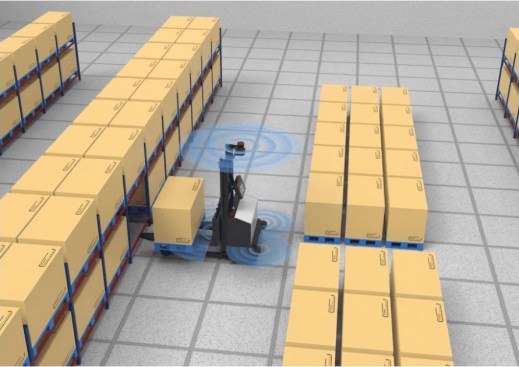
Modern autonomous forklifts and AGVs rely on technologies like LiDAR, vision-based navigation, and V-SLAM to map their surroundings and plan optimal routes. These systems allow vehicles to detect obstacles, adjust paths in real time, and operate safely in dynamic environments.
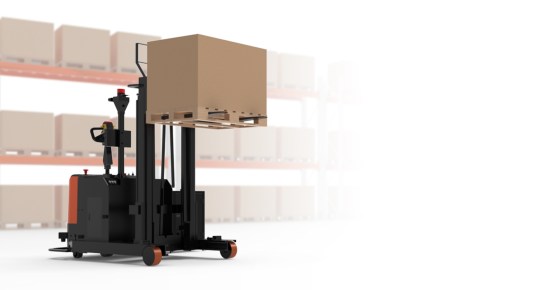
For example, Reeman integrates AI-driven navigation into its autonomous forklifts, enabling seamless movement even in narrow aisles and high-density pallet zones.
2. SLAM and V-SLAM for Real-Time Mapping
SLAM (Simultaneous Localization and Mapping) enables AGVs and forklifts to build maps of their surroundings while tracking their position within those maps.
V-SLAM (Visual SLAM) takes this a step further by combining camera-based vision with SLAM algorithms, allowing the system to identify labels, pallets, shelves, and obstacles visually.
This capability is critical for warehouses with constantly changing layouts, where static, pre-programmed paths are no longer enough.
3. IoT and Fleet Management Integration
Autonomous forklifts and AGVs often integrate with warehouse management systems (WMS) and IoT platforms, providing:
-
Real-time inventory tracking
-
Fleet optimization for task scheduling
-
Remote monitoring for predictive maintenance
This connectivity creates a fully data-driven logistics ecosystem, improving visibility across the entire warehouse.
Benefits of Autonomous Forklifts & AGVs
1. Increased Efficiency
Autonomous vehicles work 24/7, minimizing downtime and ensuring faster order fulfillment.
2. Cost Savings
By reducing reliance on manual labor, companies lower operational expenses while maximizing output per square meter.
3. Improved Safety
Equipped with 360° sensors and AI-driven obstacle detection, autonomous forklifts and AGVs reduce workplace accidents significantly.
4. Space Optimization
With precise navigation, autonomous forklifts can operate in narrow aisles, increasing storage density without expanding warehouse size.
Autonomous Forklifts vs. AGVs: Choosing the Right Solution
| Feature | Autonomous Forklifts | AGVs |
|---|---|---|
| Navigation | AI-driven with LiDAR, vision, V-SLAM | Pre-defined paths or basic SLAM |
| Flexibility | High — dynamic route planning | Limited — relies on fixed layouts |
| Payload Handling | Pallets, racks, stacking | Primarily material transport |
| Best Use Case | High-density storage & dynamic operations | Repetitive point-to-point transfers |
Key takeaway:
-
Choose AGVs for simple, repetitive material transfers.
-
Choose autonomous forklifts for complex pallet operations and high-density storage.
How Reeman Leverages These Technologies
At Reeman, we integrate laser navigation, vision-based SLAM, and AI-powered fleet management into our autonomous forklifts and AMRs. Our solutions are designed to:
-
Improve pallet-handling efficiency
-
Reduce labor dependency
-
Adapt to dynamic warehouse layouts
By combining precision navigation with intelligent software, Reeman enables businesses to achieve next-level automation in logistics.
Future Trends in Warehouse Automation
The next generation of warehouse robotics will focus on:
-
Multi-sensor fusion — Combining LiDAR, V-SLAM, ultrasonic, and AI
-
5G-enabled real-time coordination between vehicles
-
Human-robot collaboration for flexible material handling
-
Self-learning AI that continuously improves efficiency
Warehouses adopting these technologies today will be better positioned to meet future demand and stay ahead of competitors.
Conclusion
Autonomous forklifts and AGVs are redefining the way warehouses manage material flow. From precision pallet handling to real-time route optimization, these technologies enable businesses to:
-
Reduce operational costs
-
Improve efficiency
-
Boost workplace safety
By integrating AI-powered navigation and smart fleet management, companies like Reeman are helping warehouses transition to fully autonomous operations, setting a new standard for next-generation logistics.