How to Choose the Right Forklift Tonnage for Small Warehouses: ROI and Deployment Cost Explained
Date Published

Choosing the Wrong Forklift Size Costs More Than You Think
Many warehouse managers ask the same question when buying an autonomous forklift:
“Our warehouse isn’t that big—should we buy a 1-ton or a 3-ton forklift?”
It sounds simple, but behind that choice lies a serious ROI question.
The wrong forklift size affects space efficiency, energy consumption, and payback period.
If it’s too small, it can’t handle heavy loads. Too large, and it wastes valuable space and power.
This article breaks down how to choose the ideal autonomous forklift tonnage for small and medium-sized warehouses—analyzing ROI, cost, and deployment practicality with real-world examples.
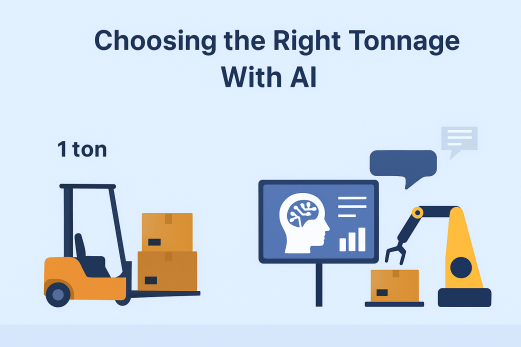
1. Evaluate Warehouse Type Before Choosing Tonnage
When selecting an unmanned forklift, the first step is to assess your warehouse type, load weight, and aisle width.
For small and mid-size facilities (1,000–3,000㎡), forklift tonnage should match real operations, not assumptions.
Here are three typical scenarios:
Scenario 1: E-commerce Warehouses — Light Load, High Frequency
-
Typical Load: 300–600 kg per pallet
-
Aisle Width: ~1.2 m
-
Daily Trips: 300–500
-
Recommended Forklift: 1-ton autonomous forklift
These warehouses need flexibility and continuous operation.
For example, the Reeman Mini Autonomous Forklift can pass through 1.1-meter aisles with ease and carry up to 500 kg.
It’s plug-and-play—no need for floor markers or reflective tape—and ideal for small e-commerce or retail backrooms.
Low energy use and fast deployment make it a cost-effective option for SMEs.
Scenario 2: Manufacturing Material Warehouses — Mid Load, Cross-Zone Operation
-
Typical Load: 600–1200 kg
-
Aisle Width: 1.5–2 m
-
Daily Trips: 200–400
-
Recommended Forklift: 1.5-ton autonomous forklift
In manufacturing settings, stability and endurance matter more than speed.
The Reeman 1.5T Smart Forklift combines laser SLAM + 3D obstacle avoidance, supports multi-floor elevator operations, and integrates easily with WMS or MES systems.
ROI usually falls within 10–12 months, making it a strong fit for mid-sized factories that want reliability without over-investing.
Scenario 3: Full Pallet Warehouses — Heavy Load, Low Frequency
-
Typical Load: 1–2 tons
-
Aisle Width: 2+ m
-
Daily Trips: 100–200
-
Recommended Forklift: 3-ton autonomous forklift
2. ROI Calculation: Is the Investment Worth It?
The key to measuring ROI is simple:
ROI = Annual Cost Savings ÷ Total Investment
Let’s take a 1.5-ton autonomous forklift as an example:
-
Equipment + deployment cost: $35,000 USD
-
Labor savings: replaces 2 forklift drivers (avg. $6,000/month × 12 months = $144,000/year)
-
Energy & maintenance savings: ~$3,000/year
→ ROI payback period ≈ 35,000 ÷ (144,000 + 3,000) ≈ 3 months (for high-labor-cost regions)
→ Even in China or Southeast Asia, payback is usually under 1.5 years
Over a 3-year lifecycle, a single forklift can save over $40,000 in operating costs while maintaining consistent 24/7 uptime—no fatigue, no overtime pay, no accident risk.
3. Deployment Costs: What You Should Watch Out For
Choosing the right forklift is one thing; deploying it efficiently is another.
Hidden costs often arise in three areas: navigation setup, network infrastructure, and maintenance.
1. Navigation Setup
Older AGVs rely on magnetic tape or reflectors—costly and inflexible.
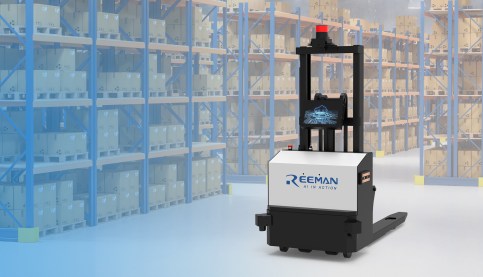
Modern forklifts like Reeman’s SLAM-based models use pure laser navigation, mapping the warehouse without modifying floors.
Average deployment time: under 3 days.
2. Network and Fleet Management
A reliable Fleet Management System (FMS) is essential for multi-vehicle coordination.
Reeman’s proprietary FMS connects directly with WMS/MES systems.
If using third-party software, expect additional API integration costs (+10–15%).
3. Maintenance and After-Sales
Standard maintenance: twice a year, around $150–200 per session.
AI-driven predictive maintenance can reduce manual inspection needs, detecting battery or wheel wear before failure occurs.
4. ROI in Practice: Real Case Snapshot
A mid-sized electronics manufacturer in Dongguan replaced two manual forklifts with three Reeman 1.5T units.
Within the first year, they achieved:
-
Labor savings: 26%
-
Material handling accuracy: +18%
-
Payback period: 11 months
By Year 2, they expanded to 8 units—covering the entire warehouse with zero additional staff.
5. Key Takeaways: Buy “Smart Enough,” Not “Biggest Possible”
For small and mid-sized warehouses, overbuying forklift capacity is a common—and costly—mistake.
Before purchasing, always consider:
-
Actual load weight and aisle width
-
ROI timeline and energy efficiency
-
Maintenance and deployment scalability
As a rule of thumb:
“The best forklift isn’t the biggest—it’s the one that fits your operations perfectly.”