
How to Evaluate the Accuracy of a Robotic Arm? A Clear Guide for Buyers and Engineers
Date Published

In industrial automation, precision matters. Whether you’re designing an automated production line or testing robotic performance in the lab, understanding how to evaluate the accuracy of a robotic arm is essential.
This article explains what accuracy means, how it’s measured, and what factors influence it—so you can choose the right robotic arm for your needs.
What Is Robotic Arm Accuracy?
Accuracy refers to how close the robotic arm’s end-effector (such as a gripper or welding tool) reaches the intended target position. It’s about whether the robot gets to the right place.
Accuracy is often confused with two related terms:
-
Repeatability: How consistent the robot is when trying to reach the same position multiple times.
-
Resolution: The smallest detectable or controllable change in movement.
Key difference: Accuracy tells you how close to the target the robot gets. Repeatability tells you how consistent it is each time.
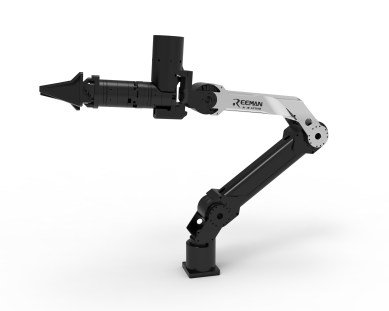
Key Metrics to Evaluate Robotic Arm Accuracy
There are several standardized ways to measure robotic accuracy. The most commonly used are:
1. ISO 9283 Standard
This international standard defines how to test a robot’s performance, including:
-
Pose accuracy: Deviation between the actual and target position of the end-effector.
-
Pose repeatability: Deviation between repeated attempts at the same pose.
-
Path accuracy: Error while following a predefined path.
2. Units of Accuracy
Accuracy is usually measured in millimeters (mm) or micrometers (μm). For example:
-
Lab-grade robotic arms: ±0.02 mm
-
General industrial arms: ±0.1 – ±0.3 mm
-
Heavy-duty arms: ±0.5 mm or more
3. Laser Tracker Testing
High-end evaluations use laser tracking systems to measure the robot’s real-time position with sub-millimeter precision.
What Affects Robotic Arm Accuracy?
Knowing the influencing factors helps you assess whether an arm can meet your requirements:
| Factor | Explanation |
|---|---|
| Mechanical structure | Length, stiffness, and joint design affect positional error. |
| Encoder resolution | Higher-resolution encoders provide more precise feedback. |
| Control algorithms | Advanced motion control reduces overshoot and vibration. |
| Load and temperature | Weight or heat may cause material expansion and bending. |
| Calibration | Proper calibration greatly improves initial positioning accuracy. |
How Much Accuracy Do You Need? (Use-Case Scenarios)
Different applications require different levels of accuracy. Here’s a quick reference table:
| Application | Recommended Accuracy |
|---|---|
| PCB Assembly | ≤ ±0.05 mm |
| Vision-guided Dispensing | ≤ ±0.1 mm |
| Warehouse Handling | ≤ ±0.5 mm |
| Robotic Welding | ≤ ±0.2 mm |
👉 If your task involves precise placement or micro-assembly, prioritize high accuracy.
👉 If you’re doing logistics or repetitive loading, focus on repeatability.
How to Test or Validate Accuracy?
Before purchasing or integrating a robotic arm, it’s best to:
✅ Use Independent Test Reports
Check for ISO 9283 certifications or third-party lab evaluations.
✅ Test Full Arm Motion
Accuracy should be assessed across all joints—not just a single axis.
✅ Simulate Your Actual Use Case
Run the robot on your task path and measure deviation.
Common Misconceptions to Avoid
-
“Repeatability = Accuracy”
Not true. A robot may return to the same wrong position every time. -
Ignoring software control
The robot’s controller and firmware greatly impact real-world accuracy. -
Assuming imported = better
Some domestic brands now offer ±0.02 mm accuracy—competitive with top international brands.
Final Thoughts: Accuracy Drives ROI
Knowing how to evaluate robotic arm accuracy helps you reduce downtime, avoid product defects, and maximize automation value. It’s not just about specs on paper—test results, calibration, and real-world application all matter.
So before choosing a robotic arm, always ask:
-
What’s the positional accuracy under load?
-
Has it been tested according to ISO standards?
-
Will it meet my actual use-case tolerance?
Answering these questions will help you avoid costly mistakes and ensure long-term system stability.
💡 Don’t miss our next guide: How to Balance Accuracy and Speed?