
Is Gemini On-Device the Android for Robots?
Date Published

Is Gemini On-Device the Android for Robots?
With the launch of Gemini Robotics On-Device, Google DeepMind is taking a bold step toward shaping an AI-native platform for robotics. While the system isn’t fully open source, its SDK-first strategy, selective openness, and growing cross-device compatibility suggest the beginning of a potential “Android moment” for embodied AI.
Let’s break down what’s truly open, what’s still controlled, and why this might matter to developers and robotics OEMs.
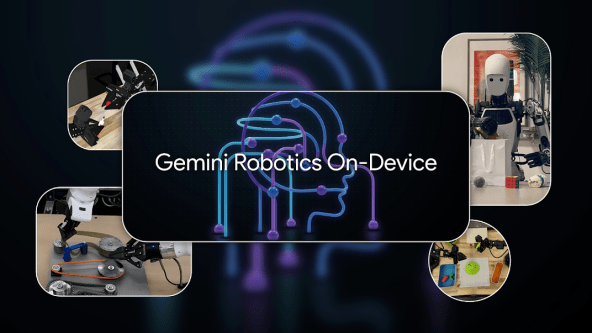
🔒 Limited Openness: Not Open Source, But SDK-Driven
Gemini Robotics On-Device does not release its model weights. Instead, Google provides access through a “Trusted Tester Program”, allowing approved developers to use Gemini models and SDKs locally on compatible robots.
According to official DeepMind releases, the current list of verified hardware compatibility includes:
✅ Verified Compatible Robots
-
Google ALOHA (Dual-arm robot)
-
A lightweight bimanual robot platform by Google.
-
Use cases: household tasks (e.g., folding laundry), precision assembly.
-
-
Franka Emika FR3
-
German-made collaborative robot with advanced force control.
-
Use cases: fine manipulation, industrial assembly, deformable objects.
-
-
Apptronik Apollo
-
US-developed humanoid robot.
-
Use cases: generalized object manipulation in unstructured environments.
-
⚙️ Cross-Platform Adaptation Architecture
Gemini’s models use standardized motion abstraction layers, enabling commands to be translated across robot types. Developers need minimal fine-tuning (50–100 task demos) to adapt Gemini to new hardware.
Google states the system is hardware-agnostic by design, with planned expansion to brands like Boston Dynamics and UBTech.
🛠 SDK and Developer Tools
While the core models are closed, the Gemini Robotics SDK is available upon request. It supports:
-
Local inference and control integration
-
Physics simulation via MuJoCo
-
Debugging and testing in simulated environments
Much like Android Studio, this toolkit lowers barriers to entry—without granting full access to the AI engine inside.
🔓 Selective Model Adaptation
Developers are now allowed to fine-tune Gemini models locally, using just a few dozen demonstrations. This semi-open model:
-
Enables rapid prototyping
-
Encourages adaptation without exposing core IP
-
Reflects Android’s API openness—but with tighter constraints
🔐 Transparent Safety Architecture
Gemini incorporates semantic safety filters, physical limit controllers, and runtime benchmarks. Google has published design principles similar to Android’s security patch lifecycle, requiring developers to implement baseline safety protocols.
📊 Android vs Gemini Robotics: Key Differences
| Feature | Android (AOSP) | Gemini Robotics On-Device |
|---|---|---|
| Source Code | Fully open | Closed weights, SDK access |
| Developer Tools | Android Studio (free) | Gemini SDK (request-only) |
| Hardware Compatibility | OEM-agnostic | Certified robots, growing list |
| Ecosystem Control | Partially Google | Fully Google-controlled |
| Model Customization | Full at OS level | Limited fine-tuning only |
Gemini’s approach is less open than Android, but similar in its push toward a standardized, SDK-based, multi-device AI platform.
🌍 The ALOHA Exception: True Open Source Robotics
Notably, Google and Stanford’s ALOHA 2 robot—a key training platform for Gemini—is fully open source:
-
Hardware: All CAD files, schematics, and mechanical parts are public.
-
Software: Control code and teleoperation frameworks are on GitHub.
-
Simulation: Integrated with MuJoCo for virtual prototyping.
-
Cost: ~$28,000 (USD), much cheaper than traditional robots like PR2.
ALOHA’s full-stack openness makes it a powerful entry point for developers seeking control, customization, and academic-grade reproducibility.
🔗 ALOHA 2 Official Site
📖 Paper: ALOHA 2: An Enhanced Low-Cost Hardware for Bimanual Teleoperation
🔮 What’s Next: A Gradual Path Toward Openness?
Google may follow a phased rollout, similar to Android’s early years:
-
2025: Expand trusted tester program and SDK coverage
-
Mid-term: Release smaller local models for edge devices
-
Long-term: Open parts of the control layer or motion planning APIs
But full model weights may never be released—Google appears set on balancing ecosystem growth with IP protection.
💡 Conclusion: Gemini Isn’t Open, but It’s Growing
Gemini Robotics On-Device is not open-source Android—but it may be Android-like in ambition.
By combining SDK access, cross-platform abstraction, and modular safety features, DeepMind is building a semi-open ecosystem that empowers developers—while retaining control over the AI brain itself.
If you want full openness, platforms like ALOHA 2 or community projects like OpenX-Embodied are more aligned. But for cutting-edge multimodal AI on real-world robots, Gemini’s hybrid strategy is one of the most pragmatic and promising available today.
Reeman robots are fully prepared for this significant moment! Let’s all welcome the arrival of the new era together.