Narrow-Aisle Autonomous Forklift Driving Factory Space Value
Date Published

Over the past decade, manufacturing has shown a clear trend: factories are not becoming bigger but denser. Rising real estate costs, the expense of new facilities, and increasingly compact production layouts have pushed many factories to maximize space within existing buildings. As aisles narrow, racks increase in height, and goods are stored more densely, manual forklift operations become harder and logistics bottlenecks grow more severe.
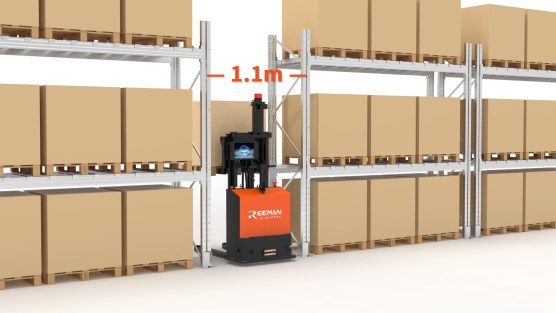
This is where narrow-aisle autonomous forklifts—especially compact AMR models like Reeman that can pass through 1.1-meter aisles with just a 1.3-meter turning radius—fundamentally change the space equation. These machines are not simple replacements for manual forklifts; they reshape the logic of factory space value. Areas previously abandoned due to insufficient aisle width now become usable. Space once reserved for forklift turning becomes new storage capacity. Layouts that once required wide spacing for human operation can now be designed far more compactly without sacrificing logistics flow.
Improving space utilization is a direct upgrade to production capacity. A narrow-aisle autonomous forklift with 1-ton load capacity and 1-meter lift height becomes a true productivity driver in high-density warehouses and production lines. It can work in areas where even human operators feel the space is too tight, automatically identifying, adjusting, and forking pallets even when placements are slightly misaligned—something traditional AGVs and manual forklifts struggle to handle consistently in dense environments.
AMR technology excels through its ability to “understand” its surroundings. In spaces crowded with goods, pillars, and mixed traffic, traditional AGVs repeatedly trigger obstacle stops, causing queues or complete standstills. A narrow-aisle AMR, on the other hand, replans paths in real time, never getting stuck behind a single obstacle. Its flexibility makes it perform even better in high-density conditions.
Reeman’s compact models are already deployed across numerous factories, operating daily within narrow aisles and dense storage zones. Because they require no site reconstruction to begin running, factories can adopt them rapidly. Many companies originally planned warehouse expansions but discovered that, with narrow-aisle autonomous forklifts, their existing space could last several more years—or double its effective capacity. For manufacturing, this offers significantly faster ROI and more practical value than building new facilities.
As factories evolve toward higher density, flexibility, and digitalization, narrow-aisle autonomous forklifts are no longer just equipment—they are space-value multipliers. They enable the same building to produce more output, the same logistics routes to flow more efficiently, and the same workforce structure to operate more lightly. Reeman’s AMR-based mini forklifts offer one of the most realistic, future-ready solutions for this transition.