
Robotic Arm Selection Guide: How to Balance Accuracy and Speed?
Date Published

In the world of industrial automation, choosing the right robotic arm is more than just picking a brand or a price. One of the most critical trade-offs lies between precision (accuracy and repeatability) and speed (cycle time and motion efficiency). Understanding how to strike this balance is key to achieving better productivity and return on investment (ROI) in your automation project.
This guide helps answer a common question among engineers and buyers alike:
Should I prioritize accuracy or speed when selecting a robotic arm for industrial use?
What Does Accuracy in a Robotic Arm Mean?
Accuracy refers to how close the robotic arm can position its end effector to the target location. It is often measured in millimeters. High-precision robotic arms may offer accuracy up to ±0.01 mm, which is crucial for tasks like:
-
Micro-assembly
-
Semiconductor manufacturing
-
Lab automation
-
Laser engraving or welding
Repeatability—how consistently the arm returns to the same position—is equally important, especially in repetitive tasks.

What Does Speed in a Robotic Arm Refer To?
Speed is measured by how fast a robotic arm completes a given motion or task. It’s typically defined in terms of:
-
Cycle time
-
Joint speed (°/s or mm/s)
-
Payload while moving at speed
Speed becomes critical in scenarios such as:
-
High-speed pick and place
-
Packaging and palletizing
-
Logistics and warehousing
-
Automotive production lines
Faster arms can process more units per hour, reducing labor costs.
The Trade-Off: Accuracy vs. Speed
You might ask: Can’t I just buy a robotic arm that’s both fast and precise?
In theory, yes—but in practice, higher precision often comes at the cost of reduced speed and increased price.
Here’s why:
-
Ultra-precise systems require better encoders, stiffer joints, and advanced control software—all of which can slow down max speed.
-
High-speed arms often sacrifice fine-grain accuracy to reduce latency and improve throughput.
Rule of Thumb
| Application | Prioritize | Example |
|---|---|---|
| Micro-assembly, PCB soldering, laser work | Accuracy | ±0.01–0.05 mm robotic arms |
| Packaging, palletizing, material handling | Speed | High-speed SCARA or delta robots |
| General automation | Balanced specs | 6-axis industrial robotic arms with medium specs |
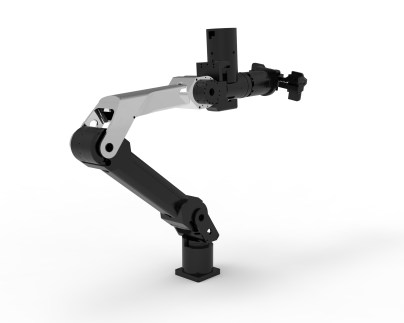
How to Choose the Right Robotic Arm?
Ask yourself:
-
What’s the tolerance level of my task?
-
Do I need high throughput or pinpoint precision?
-
What’s my budget?
-
Is the task repetitive or adaptive?
You may also consider hybrid options—for example, using a high-speed arm for rough positioning and a smaller, more accurate end-effector for fine tasks.
Final Thoughts
Balancing precision and speed is not about picking one over the other—it’s about aligning them with your actual use case.
Choosing the best robotic arm for industrial automation depends on:
-
Task-specific requirements
-
Tolerance levels
-
Budget constraints
-
Deployment environment
By understanding your production goals and constraints, you’ll be better equipped to make an informed decision—and avoid costly mismatches.
🔍 Are you still hesitating between domestic brands and international brands?
Don’t miss our next article:
“Domestic Robotic Arm vs. Imported Robotic Arm: A Precision Showdown That Cannot Be Ignored”