
Why Traditional AGVs Drift While Modern AMR Robots Get More Accurate Over Time
Date Published

Why Do AGVs Drift While AMRs Stay Precise? Here’s the Real Reason.
Many factory owners worry:
“Will the robot get lost? Will it drift off-path after running for a while?”
These concerns mostly come from past experiences with outdated AGVs getting stuck, colliding, or freezing mid-route.
But the truth is simple:
Getting lost is an AGV problem, not an AMR problem.
This article explains why.
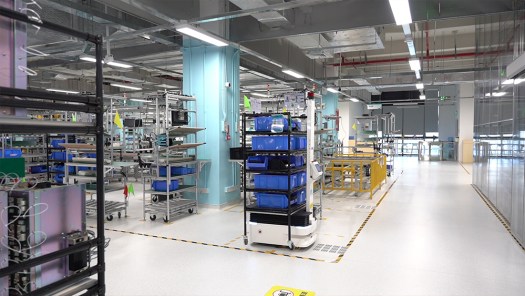
1. Why Traditional AGVs Drift or Get Stuck
① AGVs Depend Too Much on Ground Markers
AGVs rely on:
-
Magnetic strips
-
QR codes
-
Reflective markers
If any of these are:
-
Worn out
-
Covered
-
Damaged
-
Slightly misaligned
…the AGV loses its path, stops, or drifts immediately.
② Any Small Environmental Change Causes Confusion
AGVs struggle when:
-
A cardboard box appears on the ground
-
A pallet shifts by a few centimeters
-
A forklift blocks part of the route
AGVs cannot dynamically reroute and simply stop, waiting for human rescue.
③ One Blockage → Entire Line Stops
Because AGVs follow fixed “railway-style” paths, if one unit is blocked:
-
All AGVs behind it are stuck
-
The entire line collapses
-
Efficiency drops drastically
This is why many factories feel AGVs are “unreliable”—the technology is rigid and outdated.
2. Why Modern AMR Robots Become More Accurate with Use
① SLAM Navigation — No Magnetic Strips, No QR Codes
AMRs use real-time SLAM to:
-
Scan the environment
-
Build maps
-
Self-locate
-
Plan optimal routes
If the environment changes, AMR simply remaps and keeps working.
② Laser + 3D Vision = Understanding the Real World
AMRs can detect:
-
People
-
Forklifts
-
Dropped materials
-
Pallet feet
-
Low-height obstacles
-
Temporary objects
The richer the perception, the more precise the navigation.
③ They Don’t Stop — They Reroute Automatically
If an obstacle appears, AMR reacts like a skilled human driver:
-
Reroutes
-
Slows down
-
Avoids congestion
No human intervention needed, no “dead robot zones”.
④ The More They Run, the More Accurate They Get
AMR maps continually refine over time:
-
Position accuracy improves
-
Navigation becomes smoother
-
Path optimization becomes smarter
Unlike AGVs, AMRs never “drift with age”.
They get better with age.
3. Why So Many Factories Choose Reeman AMR Robots First
① Proven in Highly Complex, Real-World Environments
Reeman AMRs run in:
-
Electronics factories
-
Home appliance plants
-
New energy workshops
-
Multi-floor logistics centers
Environments with clutter, intersections, mixed traffic, and constant changes.
② Dual Sensing (Laser + 3D Camera) for High-Precision Navigation
They detect:
-
Low-height obstacles
-
Overhanging objects
-
Transparent crates
-
Narrow pallet edges
Where traditional AGVs frequently fail.
③ Advanced Multi-Robot Coordination
The dispatch system handles:
-
Auto traffic avoidance
-
Load balancing
-
Route optimization
-
Congestion prevention
The more complex the site, the stronger the AMR advantage.
④ Autonomous Elevator Integration
AGVs cannot take elevators.
Reeman AMRs can:
-
Call the elevator
-
Enter safely
-
Navigate to the correct floor
-
Continue tasks seamlessly
Essential for multi-floor logistics.
⑤ Validated With Millions of Operating Kilometers
With thousands of deployed units, Reeman AMRs have proven:
-
No drifting
-
No random stops
-
No getting lost
Stable operation is the default.
AGVs Drift, AMRs Improve — The Future Is Clear
If your factory has:
-
Narrow aisles
-
Dynamic traffic
-
Frequent layout changes
-
Multi-floor operations
Then AGVs will struggle, but AMRs will thrive.
Reeman AMRs don’t just “stay accurate”—
they get increasingly precise the more they run