Will Multiple AMR Robots Get in Each Other’s Way? How Reeman Ensures “The More, the More Stable”
Date Published

Why Factory Owners Worry About “Too Many Robots”
When factory managers first see one AMR running, the movement looks flexible and intelligent.
But once they consider deploying ten, twenty, or even more robots, doubts emerge:
Will they collide?
Will they block the aisles?
Will traffic become chaotic?
Will the entire system freeze?
These concerns are common for any factory planning large-scale automation.
However, the truth is the opposite: with more AMRs, internal logistics becomes smoother, more organized, and far more efficient—especially with Reeman’s advanced fleet coordination system.
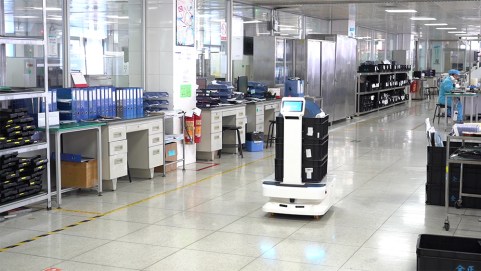
Why Traditional AGVs Become Chaotic in Multi-Machine Scenarios
Traditional AGVs operate independently.
Each follows a fixed, pre-set path.
When several AGVs share the same route, problems quickly appear:
• frequent blocking
• long queues
• inability to reroute
• reliance on manual rescue
• full-line shutdowns when one AGV stops
AGVs cannot adjust based on the real-time environment.
As the fleet grows, the system becomes unstable.
Reeman AMR: Not Individual Robots, but a Smart Coordinated System
Reeman AMRs operate under a central intelligent scheduling system.
Every robot is part of a connected network where the system continuously calculates:
• robot location
• current speed
• traffic conditions
• obstacle distribution
• task priority
• avoidance rules
They do not move independently; they cooperate.
They make decisions as a unified system, not as isolated vehicles.
Example: Two robots meet head-on
Humans hesitate and signal to each other.
AGVs freeze.
Reeman AMRs instantly determine who should pass first based on real-time rules.
Example: A passage becomes blocked
Manual carts pile up.
AGVs stop and wait.
Reeman AMRs automatically reroute and keep the workflow continuous.
Example: Sudden task surge
Humans become disorganized.
Reeman AMRs reprioritize the queue and ensure urgent tasks are completed first.
Larger Fleets Become More Stable, Not More Chaotic
Reeman’s advanced scheduling makes the entire fleet smoother as robot count increases.
More robots mean:
• more optimized route planning
• more efficient task allocation
• better congestion avoidance
• smoother traffic flow
• higher productivity
This is why factories deploying dozens of AMRs often experience increased stability, not greater disorder.
Supports Multi-Floor and Complex Logistics Networks
Reeman AMR systems also support:
• multi-floor dispatching
• elevator integration
• multi-zone transportation
• cross-workshop collaboration
• dozens of robots operating side by side
The scheduling system analyzes route congestion, adjusts task paths, and ensures factory-wide logistics balance.
As the network grows, the factory gains:
• predictable delivery times
• consistent operational rhythm
• fewer bottlenecks
• zero robot conflicts
• fully automated internal transportation
This level of order is impossible in manual operations.
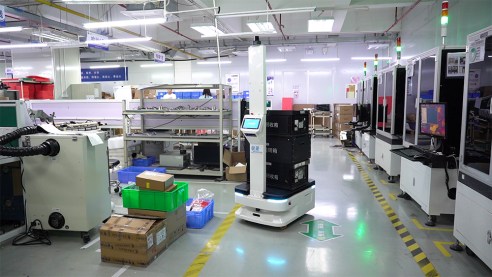
Humans Create Chaos, AMR Systems Create Order
Many owners worry that “more robots will create more confusion.”
In reality, the era with the most confusion is the manual logistics era.
Reeman’s AMR fleet coordination system brings factories into a new age of structured, reliable, and scalable logistics.
More robots means:
More stability.
More efficiency.
More throughput.
Reeman AMR doesn’t get chaotic with scale—it gets better.