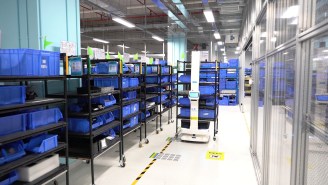
Automotive Factory Material Handling Efficiency: The Role of Reeman AMRs
Date Published

In the modern industrial sector, Automotive Factory Material Handling Efficiency has become the primary benchmark for assessing a plant’s operational health. As the complexity of vehicle components increases, manual transport systems often fail to keep pace with rapid production cycles. Consequently, prioritizing your Automotive Factory Material Handling Efficiency by deploying Reeman’s autonomous mobile robots—such as the Ironhide and Rhinoceros series—is now a fundamental requirement for staying competitive.
How Reeman Robots Boost Automotive Factory Material Handling Efficiency
The most significant contribution to high Automotive Factory Material Handling Efficiency is the elimination of repetitive manual labor. Traditionally, workers spent a large portion of their shifts moving heavy pallets between storage areas and production lines, which often led to physical fatigue and logistical delays. However, because an Automotive Factory Material Handling Efficiency solution utilizes high-load AMRs, these machines can transport engine blocks and chassis parts autonomously. Therefore, the human workforce can be reassigned to more technical and value-added tasks.
Furthermore, these robots provide a level of precision that manual forklifts cannot consistently match. While human drivers may struggle with narrow aisles or crowded floor layouts, a robot designed for Automotive Factory Material Handling Efficiency uses 3D SLAM navigation to move with millimeter-level accuracy. Instead of causing accidental damage to expensive car parts, the Reeman AMR follows optimized paths to ensure every delivery is safe and timely. This consistency is vital for maintaining a smooth “Just-in-Time” manufacturing workflow.
Future Trends in Automotive Factory Material Handling Efficiency
To achieve long-term growth, managers must look toward a scalable Automotive Factory Material Handling Efficiency model. Reeman’s intelligent fleet management software allows for the coordination of multiple robots across different sections of the plant. This digital integration supports a higher level of Automotive Factory Material Handling Efficiency through several key features:
-
Real-Time Fleet Tracking: Monitoring the exact location and battery status of every AMR unit.
-
Dynamic Path Planning: Automatically recalculating routes to avoid temporary floor obstructions.
-
Seamless System Integration: Connecting directly with your factory’s MES or WMS for automated task dispatching.
In addition to these technical features, the overall safety of the manufacturing environment is greatly improved. By reducing the reliance on human-operated vehicles in high-traffic zones, you significantly lower the risk of workplace collisions. In conclusion, if you are searching for a reliable way to optimize your internal logistics, investing in Automotive Factory Material Handling Efficiency through Reeman’s AMR technology is the most effective and future-proof strategy available.