
Gemini On‑Device vs Cloud: Why DeepMind Chooses Edge AI for Robots
Date Published

The robotics industry is entering a new era. With Gemini On‑Device, DeepMind has shifted its focus from cloud-based systems to AI at the edge. Instead of relying on remote servers, robots can now process data and make decisions locally.
This change offers big advantages: faster reaction times, better data privacy, and independence from internet access.
What Is Edge AI, and Why Now?
Edge AI means AI runs directly on the robot—not in the cloud. In traditional robotics, tasks like object detection, speech recognition, or planning require a round trip to a data center.
That causes:
-
🚫 Delays
-
🧩 Risks in poor network conditions
-
🔓 Privacy concerns
Gemini On‑Device solves this. Robots powered by Gemini can see, hear, understand, and act in real time—without sending data away.
The VLA Advantage: Gemini’s Core Strength
At the center of Gemini is its VLA model: Video, Language, Action.
It allows robots to:
-
Connect vision, speech, and motion
-
Learn from just 50–100 examples
-
Adapt fast to new tasks and environments
This is much more efficient than traditional models that need thousands of samples. With VLA, companies can save time, reduce costs, and deploy smarter robots faster.
Why Edge Wins: Real‑World Applications
Edge AI isn’t just theory. It’s already changing how robots perform in the field.
Take Reeman, a company that designs a wide range of service robots—including logistics robots, disinfection robots, unmanned forklifts, delivery robots, humanoid robots, guide robots, and robotic arms. With edge AI:
-
Robots can navigate complex, dynamic environments more accurately
-
They avoid delays caused by cloud connectivity
-
They quickly adapt to new layouts or tasks without full system upgrades
This means faster responses, lower maintenance, and smarter automation across industries—from warehouses and hospitals to restaurants and public venues.
ALOHA 2: Open Source Training for Gemini Robots
To help developers adopt edge AI, DeepMind and Stanford introduced ALOHA 2—an open-source platform for training robotic arms using Gemini models.
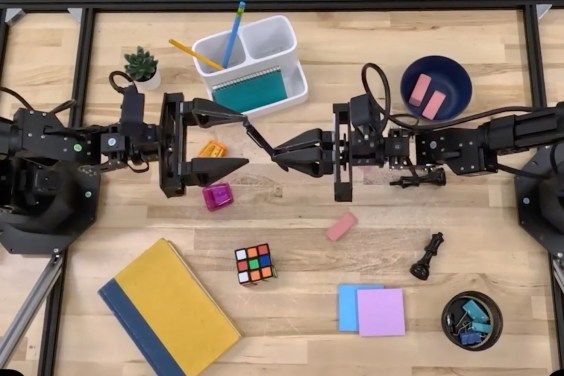
With ALOHA 2, developers can:
-
Simulate real-world tasks
-
Fine-tune on-device behavior
-
Build smarter systems faster
Find the toolkit on ALOHA 2 GitHub and learn more via the DeepMind blog.
Final Thoughts: Edge AI Is the Future
Gemini On‑Device proves that robots don’t need cloud servers to be intelligent.
They can:
-
Think locally
-
Respond instantly
-
Protect user data
-
Work anywhere—even offline
As the robotics world shifts toward edge computing, companies using solutions like Gemini will lead the next wave of innovation—in homes, factories, and beyond.