
Reeman AMR Robots: The Essential Gateway to the Factory of the Future
Date Published

As Industry 4.0 and smart manufacturing accelerate worldwide, the factory of the future is no longer a place filled with machines and manpower alone. It is an intelligent, data-driven, highly flexible ecosystem where material flow, information flow, and production flow operate in perfect sync.
In this transformation, one technology is quickly becoming standard equipment—Reeman AMR robots.
1. AGV Belongs to the Past; AMR Belongs to Industry 4.0
Traditional AGVs were built for predictable, repetitive workflows. Their biggest weakness? Rigidity.
-
They rely on fixed magnetic strips or QR markers
-
Any route change requires construction
-
They cannot respond to dynamic obstacles or layout changes
AGVs are the “legacy tools” of Industry 2.0 and 3.0—too static, too fragile, and too costly to modify.
Reeman AMR robots, however, reflect the core traits of Industry 4.0:
-
Autonomous decision-making
-
Real-time environmental perception
-
Zero-modification deployment
-
Dynamic route planning
-
Intelligent multi-robot coordination
Where AGVs follow the road, AMRs think, plan, and adapt—exactly what future factories need.
2. AMRs Are the “Smart Bloodstream” of Future Factories
In modern production, materials must flow with precision, speed, and intelligence.
Reeman AMR robots connect:
-
Raw material warehouses
-
Production lines
-
Line-side storage
-
Assembly cells
-
Finished goods warehouses
This turns isolated production nodes into a fully integrated, data-driven logistics network.
Reeman AMRs integrate with MES, WMS, ERP, enabling:
✔ Real-time task execution
✔ Location tracking and digital traceability
✔ Automated material replenishment
✔ Closed-loop production logistics
They become mobile, intelligent endpoints within the digital factory—where data no longer stays in the system but actively drives physical actions.
3. Reeman AMRs Lower the Threshold to Industry 4.0
For years, building a “lights-out factory” seemed achievable only for large corporations because:
-
AGV systems were extremely expensive
-
Integration required heavy infrastructure construction
-
ROI cycles were long and risky
Reeman changed that.
Reeman AMR robots cost as little as one-tenth of traditional AGVs, while delivering:
-
Higher flexibility
-
Faster deployment
-
Lower maintenance
-
Greater scalability
Factories no longer need a massive upfront investment. They can start with:
-
One line
-
One workshop
-
A single AMR unit
… and expand gradually like building blocks, minimizing risk while accelerating transformation.
This democratizes Industry 4.0 automation for small and medium-sized manufacturers.
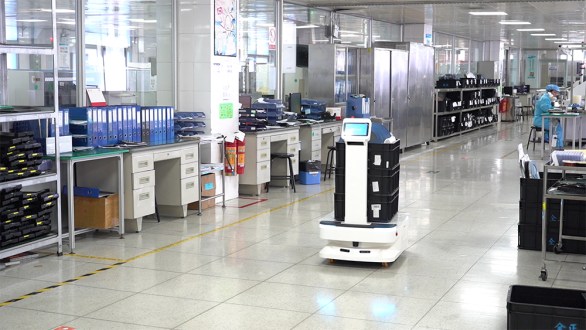
4. AMR Logistics Reshapes the Entire Production Architecture
When Reeman AMRs take over material handling:
-
Production lines can be arranged more compactly
-
Human walking time and waiting time are eliminated
-
Buffer inventory is reduced dramatically
-
Bottlenecks are removed
-
Production cycles accelerate
In many factories, switching from manual or AGV logistics to Reeman AMRs has allowed:
-
Up to 40% improvement in material turnaround speed
-
Up to 30% higher space utilization
-
Consistent 24/7 operation with no downtime
AMRs don’t just “replace people”—they unlock the full potential of the manufacturing system.
5. In the Future, a Factory Without AMRs Will Be Like a Factory Without Electricity
As markets demand:
-
Higher customization
-
Faster deliveries
-
Smaller batches
-
Shorter product cycles
A factory without AMRs will struggle to stay competitive—just like a factory without automation in the 1990s or without electricity in the 1900s.
Reeman AMR robots are becoming the standard infrastructure for future-ready factories:
-
Flexible
-
Scalable
-
Intelligent
-
Cost-effective
-
Interconnected
They are not “nice-to-have”—they are rapidly becoming mandatory equipment in a global race for productivity.Investing in Reeman AMR Robots Is Investing in the Future
Reeman AMR robots combine industry-leading cost efficiency with powerful autonomous technology, making Industry 4.0 accessible to factories of all sizes.
By deploying AMRs today, manufacturers are:
-
Building a foundation for transformation
-
Accelerating digitalization
-
Reducing labor dependency
-
Improving logistics speed and accuracy
-
Preparing for a fully autonomous future
Adopting Reeman AMR robots is not just an upgrade—it’s the gateway to the future factory.