Reeman AMR Robots: The Foundation of Flexible Manufacturing on Intelligent Production Lines
Date Published

Modern manufacturing is rapidly shifting toward small-batch, multi-variety production, where flexibility and fast response have become essential. Traditional logistics systems—rigid, fixed, and difficult to modify—can no longer keep pace with today’s dynamic production needs.
This is where Reeman AMR robots emerge as a game-changing enabler of true flexible manufacturing, giving factories the agility needed to reconfigure processes quickly and seamlessly.
1. True Flexibility: Adapt Without Layout Modifications
The defining advantage of Reeman AMR robots is their inherent flexibility.
Unlike AGVs that rely on magnetic strips or markers, Reeman AMRs require no physical infrastructure changes. Through software configuration, factories can instantly:
-
Adjust pickup and delivery points
-
Replan routes and mission logic
-
Respond to new workflows or layout changes
-
Scale production without additional construction
When an order change requires a process shift or rebalanced production line, AGVs may need days of reinstallation.
Reeman AMR robots adapt within minutes, simply by updating the virtual map—a critical advantage for modern flexible manufacturing.
2. Real Applications: Smart Material Handling Across the Production Line
① Process-to-process transfer
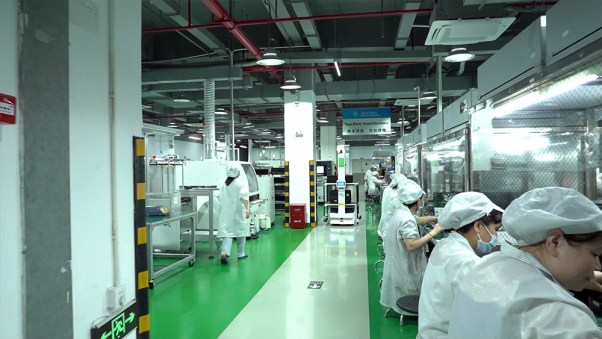
In SMT post-process lines, CNC machining centers, or multi-station assembly flows, Reeman AMR robots autonomously transport:
-
Racks
-
PCB trays
-
Precision components
This reduces the risk of static discharge or accidental impact caused by manual handling, improving product quality and consistency.
② Automatic Line-side Replenishment (JIT Delivery)
Reeman AMRs monitor material consumption in real time. When a workstation requires replenishment, an AMR automatically retrieves materials from the warehouse or supermarket and delivers them just in time.
This ensures:
-
Zero downtime due to material shortage
-
Stable production pace
-
Reduced inventory pressure on the line
③ Flexible Workcell & Modular Assembly Islands
In automotive, electronics, and home appliance manufacturing, multiple Reeman AMRs can serve as mobile assembly carriers.
They can:
-
Deliver parts to changing workstations
-
Support mixed-model or multi-variant assembly
-
Adapt to different product combinations
This enables true modular manufacturing, improving line responsiveness and reducing changeover time.
3. Making Material Flow “Adapt on Demand”
Reeman AMR robots bring unprecedented agility to production lines:
-
Material flows adjust automatically as processes change
-
Production bottlenecks are reduced through dynamic dispatching
-
High-mix, low-volume orders become easier to fulfill
-
The entire factory becomes capable of rapid line reconstruction
In short, Reeman AMRs convert static logistics into a self-adjusting, intelligent material pipeline, perfectly aligned with the evolving needs of flexible manufacturing.
Reeman AMR Robots Are the Backbone of Flexible Manufacturing
As manufacturing moves toward customization, short cycles, and unpredictable demand, the ability to reconfigure production instantly becomes a strategic advantage.
Reeman AMR robots empower factories with:
-
Layout-free deployment
-
Rapid reconfiguration
-
Autonomous scheduling
-
Full-process material automation
They are not just robots—they are the infrastructure of flexibility, giving factories the agility needed to win in fast-changing markets