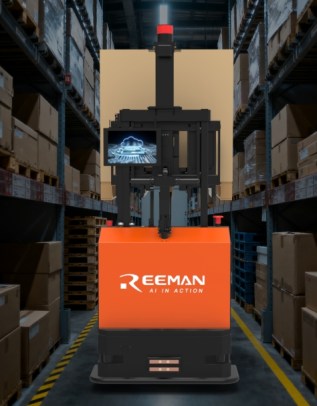
Reeman Mini 2.0 Autonomous Forklift: Maximum Reliability in Minimal Space
Date Published

In the wave of intelligent manufacturing upgrades, one common challenge stands out — limited space. As factories grow denser and production layouts become more complex, traditional autonomous forklifts often struggle to operate efficiently in narrow aisles, sharp corners, old factory buildings, and irregular layouts.
To solve this “space bottleneck,” Reeman launched the all-new Mini 2.0 Autonomous Forklift, a compact yet powerful solution designed specifically for tight industrial environments. With a smaller chassis and flexible structural design, the Mini 2.0 dramatically improves mobility and adaptability. In both internal testing and customer deployments, it has proven capable of smoothly navigating 1.1-meter-wide aisles — an operation that is nearly impossible for conventional unmanned forklifts.
Thanks to its industrial-grade compact chassis, the Mini 2.0 achieves a minimum turning radius of just 1.3 meters, making it ideal for dense warehouse zones, injection molding workshops, and electronic assembly lines.
Compact but Powerful: 1,000kg Load Capacity, 1m Lifting Height
Despite its small size, the Reeman Mini 2.0 is built for industrial strength. It supports a rated load of 1,000kg and a lifting height of 1 meter, perfectly fitting most pallet transfer and material handling needs.
What truly sets it apart is the optimized front structure, which reduces the required front clearance for pallet pickup to only 2.3 meters. This compact design minimizes space requirements in stacking areas and enables seamless automation upgrades without changing the existing layout. Many clients have directly replaced manual forklifts with the Mini 2.0, achieving automated logistics transformation with minimal disruption.
Industrial-Grade Navigation and Safety
Reliability and safety are at the heart of Reeman’s design philosophy. The Mini 2.0 integrates a robust sensor suite, including LiDAR navigation, obstacle detection, vision-based perception, and safety edge sensors. This combination ensures stable and precise operation even in dynamic, high-traffic factory environments.
Rather than chasing extreme parameters in a lab, Reeman focuses on long-term operational reliability in real-world scenarios. Through extended testing cycles, the Mini 2.0 has demonstrated smooth performance under common factory conditions, maintaining safety for both personnel and materials through multiple protection mechanisms.
Designed for Real-World Automation
The Reeman Mini 2.0 Autonomous Forklift isn’t about pushing limits — it’s about consistent, dependable operation in the environments where it matters most. It represents a practical step toward automation for factories that previously struggled with space constraints.
Compact, intelligent, and reliable — the Mini 2.0 offers manufacturers a realistic and effective path to warehouse and production line automation, bringing smart logistics to places where traditional forklifts simply can’t fit