What Is the World’s Smallest Forklift? The Power of the Mini Forklift
Date Published

When people think of forklifts, they imagine bulky machines. These traditional forklifts need wide aisles, skilled drivers, and lots of space. But in today’s compact warehouses, they often fall short. With the rise of automation, a new solution has arrived: the mini forklift.
So, what is the world’s smallest forklift? The answer lies in autonomous mini forklifts like the Reeman mini forklift. Small in size but powerful in function, it is designed to solve space and labor challenges faced by many small and medium-sized businesses.
Mini Forklifts: Small Size, Big Space Savings
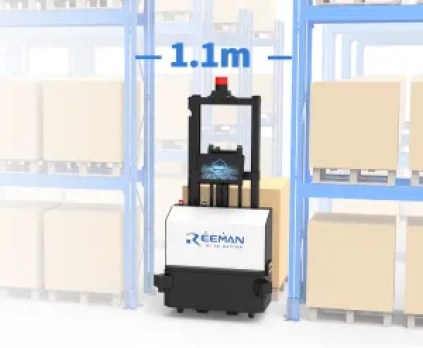
A mini forklift is not just a “shrunk” version of a traditional forklift. It is purpose-built for narrow aisles and high automation. Take the Reeman mini forklift as an example. It can pass through aisles as narrow as 1.1 meters. By comparison, traditional forklifts often require 2–3 meters. This means businesses can reduce aisle width and increase storage by over 30%.
For e-commerce warehouses and retail backrooms, space is always limited. Shelves cannot be too close, otherwise forklifts cannot pass. But if shelves are too far apart, inventory capacity drops. The Reeman mini forklift solves this conflict. It drives close to racks, aligns with pallets precisely, and even works in old warehouses without costly renovation.
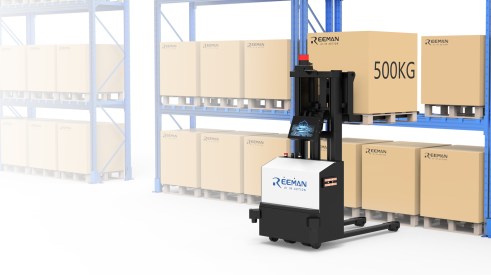
Despite its size, it delivers solid performance: a 500kg payload capacity, 1.6m lifting height, and Laser SLAM navigation. No magnetic strips or QR codes are needed. Just deploy it, adjust settings, and it is ready to work. For small businesses, this is both practical and cost-saving.
From E-Commerce to Healthcare: Wide Applications
Mini forklifts are not only about saving space. They adapt to diverse environments where traditional forklifts struggle.
E-Commerce Warehouses
During peak shopping seasons, shelves are packed and manual forklifts move slowly. The Reeman mini forklift uses 360° obstacle avoidance, detecting people, racks, and boxes in real time. It runs safely and smoothly, even in busy aisles. It also works 24/7. When the battery is low, it finds the charging dock automatically. No night shifts or extra drivers are needed.
Manufacturing Plants
Factory aisles are often narrow, and materials need frequent transport. Manual carts are slow and error-prone. The Reeman mini forklift navigates production lines autonomously. It also integrates with WMS and MES systems. If a line needs raw material, the system sends a task directly to the forklift. Materials arrive on time, reducing downtime and labor cost.
Healthcare and Multi-Floor Buildings
Hospitals and labs require safe, contactless delivery. Storage rooms are small, and supplies often move between floors. The Reeman mini forklift connects with elevators automatically. It transports medicines and supplies without human contact. This reduces contamination risks and frees staff to focus on patient care.
Why Choose Reeman Mini Forklift?
Many small forklifts still rely on human operators or lack advanced automation. Some only run fixed routes. Others cannot handle heavier pallets.
Reeman’s mini forklift is different. It combines flexibility and practicality:
-
Works in 1.1m narrow aisles
-
Lifts 500kg payloads up to 1.6m
-
Uses Laser SLAM navigation with 3D vision obstacle avoidance
-
Runs continuously with automatic charging
-
Integrates with WMS/MES for autonomous scheduling
-
Supports elevator operation for multi-floor warehouses
For small and medium businesses, this means no costly factory upgrades, no need for licensed drivers, and much faster ROI. Many users report recovering their investment in less than a year through labor savings and increased space utilization.
A Small Forklift with a Big Future
So, what is the world’s smallest forklift? The answer is the mini forklift. Small, smart, and efficient, it makes automation possible for all businesses—not just large logistics centers.
If your warehouse faces challenges such as limited space, rising labor costs, or low efficiency, the Reeman mini forklift may be the key. It fits in narrow aisles, runs 24/7, and even handles cross-floor deliveries. This little forklift could unlock big possibilities for your warehouse automation journey.